CRITICAL ESSAYS
DRAWN IN DRAWN OUT David Hansen
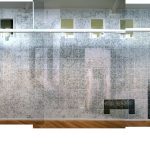
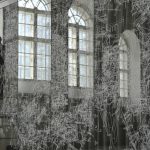
Back and forth. To and fro. In the making of this work there is always movement: between subject and object (the eye and the hand, the looking and the drawing); between thought and action (the plan and the attack, the careful, measured laying-out and the dynamic informalism of the execution); between home and away (the house and the gallery, Poland and Australia, Perth and Melbourne and Canberra). The drawing is a trace, a residue, a means of making concrete what is in many ways a performative practice. Skin of the Wall is a time-based work; a year and a half of living distilled, stilled.
Unlike the automatic drawing of surrealists like André Masson, where the line is allowed to run off into thoughtlessness, pattern, the imaginary, Wlodarczak’s drawing is directly, even tightly calibrated to the visible, to the specifics of retinal perceptions. When she draws, she walks around, stands still, sits, lies down, looks around, moving her head up and down and side to side, and each new position or transition creates a revised perspective, a refocussed field of vision. From this cascade of visibility in motion, from what the 19th century psychologist and philosopher William James called the “blooming, buzzing confusion” of sensory inputs, Wlodarczak isolates and records precise, momentary recognitions.
There are details of interior architecture and furniture: corners, cornices, window frames, light fittings, chair legs and tabletops. There are the casual accumulations of domestic space: coffee cups, power cords, ornaments, fruit, even text, in odd letters from the spines and covers of books. Finally, there are bodily encounters: fragments of her partner and collaborator Longin Sarnecki’s face (curiously, most often his nose), glances down at her own limbs, even occasional fingers – the artist’s hand drawing itself.
Significantly, none of these glimpses is developed. While some objects are immediately recognizable, it is often difficult to identify precisely where a motif or form originates, what a particular rectangle, circle or ellipse describes. Things are not given a prolonged or dedicated examination, but rather just enough attention to register a simple shape, a form, an element which can be lassoed by Wlodarczak’s relentless contour line before the eyes move on to the next object, the next vertical accent, curving profile, geometric detail…
This is a severe and constant mental and spiritual discipline, to (as Wlodarczak puts it) “record the present time continuous moment”. Located somewhere between Buddhism and existentialism, the project involves the conscious creation of unconsciousness, of a kind of “flow” state in which the artist can see (and transcribe) without comprehension, without identification, without desire, without bad faith. Distractions are helpful: constant motion, conversations with Longin (“mostly gossip”), the regular castanet rattle as he shakes up the pigment ink of the white felt tip pen.
Through this drawing-performance, she valorises the act of seeing, raising it from a preliminary to an instrumental role in art production, making it the vibrating, shimmering centre of her practice. She restores independence and equality to the act of seeing and to the things seen. It should not be thought that this hyper-spontaneity, this free, eurythmic, Pollocky dance against the picture plane is some kind of conceptual toss-off, a random neo-dada slacker gesture. Far from it. Wlodarczak’s ice-skating tracks are only the tip of a vast berg of process. The lightness and looseness is only possible because of the sturdiness and strength of the underlying infrastructure.
Skin of the Wall begins with the physical substance of its eventual destination, the west wall of the Helen Maxwell Gallery. This site was first carefully measured, drawn up and plotted with a rectilinear grid. With adjustments to accommodate interruptions and obstacles (beams, windows, exit signs, power points) and with a contingency allowance of four millimetres spacing between individual units, the wall was thus divided into a mosaic of 676 panels (most measuring 40 x 25 centimetres, some 20 x 25). There followed three months of measuring and cutting cardboard to size, then four months of cutting, folding and gluing the panels’ wallpaper coverings. Only then could the drawing begin, and that was a further five months’ work. And finally, at the end of that last process comes a reversion to the architectonic. The delicate, continuous breathing of the drawn line is broken up into panels, arranged in stacks, packets and boxes for transport, and a wall is erected in Canberra.
In addition to these material and technical systems there is another scaffolding, a grid of ideas. The ideas stand hard up against the vertical plane of the wall, the plane of division, the horizon beyond which sight cannot reach. What Skin of the Wall describes is its own physical limitations, and by metaphorical extension, the boundaries of the self.
Wlodarczak’s life has been about transition. A sailor father and a restless mother, regular childhood moves, travel across Europe and Asia, migration to Australia in 1996, relocation to Melbourne last year, five houses in the last ten years…this state of unbelonging informs much of her work. For all its tenuous, fragile, momentary character, her art provides the constant referent, the psychic refuge, the safe zone. Against the threat of insecurity she also falls back on her immediate environment, the domestic space, conflating home and possessions and the act of drawing them in a reassuring ritual of place-making. Skin of the Wall can thus also be read as a house open for inspection, a progression from one room to another through a semi-detached residence in the Melbourne suburb of Richmond, each room identifiable if not by the abbreviated and interrupted sketching of its contents, then by its distinctive wallpaper ground. In a further complication, some of the panels are darker than others, more heavily worked, making schematic, pixellated shadows: the modernist ghosts of chairs, a table, a desk lamp from the Melbourne flat Gosia and Longin rented before they bought the Richmond house.
This is Wlodarczak’s remarkable achievement: the binding together in a tangled skein of lines both private and public action, private and public space. Coming from the intellectual tradition of Eastern European communism, it is perhaps not surprising that her art is constructed in terms of Hegelian dialectics, of opposition and synthesis, tension and resolution. Or perhaps she is simply sensitive to 21st century globalisation-displacement. Either way, the result is a species of betweenness-work. The character of her line falls somewhere between the precision of an architectural blueprint and the chaos of automatism, or of Henri Michaux’s mescalin drawings, between Poland’s strong graphic culture of printmaking, book illustration and poster design and Australia’s scribbly identity draughtsmen: John Olsen, Mike Parr, Bruce Petty.
Skin of the Wall, like many of the artist’s previous projects, defies conventional curatorial definition, being neither simple drawing nor installation, nor performance, but a combination of the three. All and nothing. Neither and both. Description and abstraction. Melbourne and Canberra. The rigorous-casual, nervous-dogmatic, attentive-informal artist and the standing-moving, admiring-baffled, scanning-peering viewer. To and fro. Back and forth.
Melbourne, July 2006
DRAWN IN DRAWN OUT catalogue essay, Skin of The Wall exhibition at Helen Maxwell Gallery, Braddon ACT, Australia, 4 August – 2 September 2006.
‘ON THE SKY AND WATER, FROST DRAWING FOR THE AGNSW’, 2014
DRAWING OUT, THE DOBELL AUSTRALIAN DRAWING BIENNIAL, SYDNEY Ayar Frantz
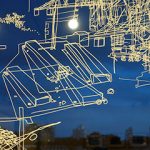
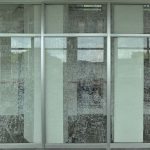
ON THE SKY AND WATER, FROST DRAWING FOR THE AGSNW, 2014, is an expansive and perfused work of art: over ten metres in length, the dimensions of the drawing are unequivocally epic in scope and size. Defiant of classic enclosure and inanimate form, the work conducts an optic shimmer of contraction and expansion upon the eye of the viewer. During installation, Wlodarczak drafted nine towering panels of liminal gallery space with an intricate web of rectilinear lines, diffused markings and ubiquitous corporate logos. Both delicate and fortified, the form of the drawing contrasted with a succession of severe aluminium frames that partitioned the window surface upon which it was executed. Besides the sole variation of the panel on the far left (an emergency exit to the roof of the gallery), the resulting modularity of the piece is rigid and symmetrically exacting in its division of the translucent surface. Stressed by this mechanistic and hyper-functional design feature is the dissent and tactility of Wlodarczak’s mark-making. Once complete and viewed at length, On the sky and water, 2014, fades both in and out of sight like the inhalation and exhalation of breath on a cold window pane.
Drawn in situ at the Art Gallery of New South Wales, On the sky and water, 2014, is both performative and conceptual. Ephemeral and, dare I say, dematerialised, it is a distillation of the structural and environmental forces that were encountered by the artist. Time, site-specificity, and the assorted variables that converged upon Wlodarczak as she drew (for instance: interruptions, conversations, fatigue and humour) were syphoned from her abstract ‘space-time’ into the linear trace and soft materiality of her white Posca marker. Interpreting such a process-based work as an aesthetic art object is not without its risk of criticism, however credence was lent to this means of communion during installation. For instance, a number of bemusing and formalistic junctures were reached and documented as it matured in size and density, most notably the variations that natural and artificial light lent to the colour and shadows of the work. Additionally, frost is a well-worn motif bearing strong picturesque connotations. In lieu of this decidedly anachronistic association, a contemporary reading of frost under the influence of Gosia’s work might instead note it as the elemental ossification of exhalation and perspiration. It is the visual evidence of affective contact.
Wlodarczak’s reinstatement of affect into conceptual practice is among the most profound achievements of ON THE SKY AND WATER, FROST DRAWING FOR THE AGSNW, 2014. It was here that the historic implications of the work truly gripped this writer: where, in the temporary absence of well-worn demarcations, system and affect collided within a work-specific contact zone. During the seven-day installation, the idealised vista of Woolloomooloo was floored by the sober aesthetic diplomacy of the artist and the democratic systematisation of her practice. Gosia did not pause to reflect upon what was seen during the act of drawing. Form, line and shape were committed to the translucent glass pane as they appeared to her eye: the artist encircled avian excrement as readily as she transposed the features of people who approached her throughout her time in the gallery. The performance proposed empirical evidence of being by way of an effective pre-cognitive exercise in drawing. Wlodarczak’s drawn line was the record of a life-force at the centre of encounters that are abstract and intangible or, conversely so, logical and rule-based.
Thrown into relief by ON THE SKY AND WATER, FROST DRAWING FOR THE AGSNW, 2014, are the myriad of ways in which the legacies of conceptual art are interpreted. Recently, historian Eve Meltzer identified conceptualism as an art of the anti-humanist turn of the sixties: a structuralist disavowal of belief in a subject that was “not only in command of themselves and a consciousness fully transparent to itself, but also the historical process.”[1] According to Meltzer, structuralism imbued the dissenting work of the mid-twentieth century. Amidst this environment of nihilistic (de)appraisal, artists harboured a keen awareness of systems and structures and a fixed affair with the so-called belatedness of subjectivity. Their works determined that the human subject was the effect of pre-existing systems and that these systems were within the scope of visual practice. Of particular note in Meltzer’s writing was her discovery of marginalised effects residing in the peripheries of conceptual art. Albeit in a unique guise, affect is illuminated in the contemporary work of Wlodarczak. Contrary to the above discourses that conceive of effect as somehow prior to or beyond subjectivity, ON THE SKY AND WATER, FROST DRAWING FOR THE AGSNW, 2014, proposes their intimacy to one another.
Ayar Frantz is a recent undergraduate of art history at the University of Sydney. In November 2014, he assisted Gosia in the installation of the discussed work On the sky and water, frost drawing for the AGNSW.
[1] Meltzer, 2012
FROST FOR THE MOSCOW MANAGE Russell Storer
Gosia Wlodarczak’s drawings trace a performing body. They are not just evidence of the movement of the artist’s hand, but also of the complex relationships between her physical senses and systems and her environment. Wlodarczak’s distinctive line—jittery yet sure, continuously linking fragments of objects, people and texts—spreads outward across the surfaces of things, be it paper, fabric or glass. Its intricate networks envelop us with information about the specific time and place that she occupies: the people she meets, how she is feeling, the temperature of the room, what catches her eye.
The glass rotunda at one end of the Manege building is the site for the latest, and largest, of Wlodarczak’s signature ‘frost drawings’. This series of drawings on glass recall the icy windows she remembers from winters in Poland, and will be instantly familiar to audiences in Moscow. In its previous iterations in the sunnier climates of Australia and Singapore, the drawings suggested parallel, otherworldly experience (Wlodarczak has described the drawings as a ‘membrane’ between one state of being and another) at the same time as registering and interacting with the present; here in Russia they seem much closer to home.
Growing up in Poland in the 1960s and 1970s, and learning Russian at school, Wlodarczak lived in the shadow of the Soviet Union. This work marks her first visit to Russia, to encounter the country that has had such enormous political and cultural impacts on her life. How these external forces became embedded within her, and how they might reveal themselves via her constantly restless hand and eye, are a crucial aspect of this work, and one that she could only realise through the process of drawing. For it is with drawing, that form of communication that reaches beyond language, that Gosia is able to understand and express her surroundings, her history, and her sense of place.
This is a newly revised version of a text originally published in the catalogue for the 5th Moscow Biennale of Contemporary Art main exhibition “More Light”, curated by Catherine De Zegher, 2013. Republished with permission.
2011 SINGAPORE BIENNALE: OPEN HOUSE
COMMISSIONED PROJECT: FROST DRAWING FOR KALLANG (2011), PERFORMATIVE DRAWING ON GLASS (IN SITU), AT THE OLD KALLANG AIRPORT, SINGAPORE BIENNALE
13 MARCH–15 MAY 2011 Dr Janet McKenzie
Polish born artist Gosia Wlodarczak completed a 12-day performative drawing in March this year for the Singapore Biennale. Frost Drawing for Kallang, (2011) is one of many extraordinary works in her energetic and dedicated art practice, in which drawing is used to index her performative art, the events and processes of experience. Since she arrived in Australia from Poland 15 years ago, she has made an innovative contribution to drawing in Australia and to contemporary art practice there and in regular projects around the world.
Wlodarczak has devised a number of ambitious performance-inspired projects and carried them out with a single mindedness and commitment. The Third Singapore Biennale opened in March led by artistic director Matthew Ngui with curators Russell Storer and Trevor Smith. The Open House programme was organised by the Singapore Art Museum. Focusing on artistic processes, the Third Singapore Biennale is marked by an exceptionally high percentage of artists who are presenting site-specific commissions. This is fitting for Wlodarczak for whom the finished product is less important than the process, in her case the performance, which yields a tightly knotted net of imagery, “thickly woven webs of line, the resulting graphic chaos of partial and disjointed motifs – random bits of architecture, furniture, tools, faces … are a capsule of frozen moments – a space-time membrane”.1
The site is also appropriate for her project. The Old Kallang Airport in Singapore was built in the 1930s as the first civil airport. It is no longer used and so inhabits something of a time warp. As the Biennale organisers point out, “the aerodrome’s original layout permitted planes to land from any direction, while its circular glass control tower gave a panopticon view to all points of the compass”. The title “frost drawing” refers to the Mandelbrot set patterns that spread over windows when the temperature is sub-zero, specifically for her in her native Poland and other parts of Eastern Europe. For Wlodarczak “the liquid flow of visual impressions, are crystallised as art, citing migrant experiences and the relentless dynamism of Singapore’s society and economy”.2
This is a spectacular work, sharing with many of her projects a great energy being executed on a large scale. Although they are not primarily formal art objects in themselves, Wlodarczak values the process over the finished product. The spatial quality of Wlodarczak’s drawing refers not only to external space such as the actual space in which her performance pieces take place, but to her own internal space – her body and the interaction thus established with the environment, domestic space or the philosophical place of the individual in the cosmos. …
References
1. www.singaporebiennale.org
2. Ibid.
CINDERELLA II – THE DREAMER Olga Sankey
Since arriving in Australia from Poland some twelve years ago, Gosia Wlodarczak has established herself as an innovative and highly individual artist whose practice centres on the act of drawing. In the artist’s own words:
My practice is made manifest through heightened awareness of dwelling in the everyday areas of human thought, behaviour and experience. Drawings are processed via the biological phenomenon of ‘being’ as detected by my sense of sight and communicated through my body. I draw my environment as I see it in real time – tracing and re-tracing the visible – thereby finding elements often concealed by the primacy of sight. My work interrogates space, time and language. Over time I have adopted various visual processes and methods to address and communicate these issues. Drawing is the basis of all my work, extending towards installation, performance, interactive situations and video and sound installations.[i]
In Cinderella II – The Dreamer, with the assistance of New Work grant from the Australia Council, Wlodarczak continues her investigation of ‘the perception of home and domestic space as a site of dreaming and habitation where the imaginary and real coexist.’[ii]
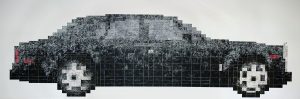
The three objects that form the basis of this exhibition are presented as ‘stylised profiles of desire’: an haute couture outfit from Yohji Yamamoto’s 2007 Spring Collection, a Rolls Royce Phantom and a Bang & Olufsen sound system Beo. Wlodarczak is making the dreams of three of her friends come true through her drawing. When they are not on the wall the works can be packed away into gift boxes made by the artist. Portability is an important aspect of this new work – theoretically each recipient can carry the box home. The artist has created a special gift for each of three friends, which represents both the materialisation of a wish they have shared with her and a record of the time she has dedicated to making it come true – a portion of her own life.
Each of the objects has an associated sound component which was created in collaboration with the Canberra based composer, Alistair Noble. Initially Wlodarczak and Noble toyed with the term ‘sound-image’ to describe the product of their collaboration, however on discovering it was already in use in the music and film industries, Wlodarczak finally settled on the word ‘Similitude’. These sound installations, Similitudes, represent ‘an aural equivalent of the visual experiences’ the artist has created for us. The idea is based on her belief that ‘everything in the world is built with/constructed of the same energy which manifests/appears itself in different forms to be experienced by human senses’ so that in her work she is ‘developing processes and codes to make translations between senses possible.’[iii]
This sense of interconnectedness, of inner cohesion, is central to Wlodarczak’s practice and the inclusion of a sound component is an extension of a very logical approach to art making. Wlodarczak has a quite singular approach to drawing. She speaks about what she does with passion. One gets the impression that it is something she has to do: a life-affirming activity. In a monograph on the artist published in 2004, David Bromfield concludes that to ask what she is drawing, is to ask the wrong question, since ‘for Gosia the verb is intransitive like the verb to be’. [iv] Drawing is looking rather than looking at; the object of drawing is not the representation of a particular environment, rather it is the documentation of being in the environment. The former suggests an automatic activity, like breathing, while the latter is a more considered, self-conscious activity.
When one is confronted with Wlodarczak’s drawing installations one sees a complex tracery of lines of varying density. In certain areas where the ground cover is sparser one can make out a hand, a cup, a part of a cornice, the side of a chair: domestic objects documented with lines of practised economy and an enviable confidence, the result of rigorous academic training. In most cases, the bulk of the drawing is executed within the artist’s home and then the final stages can be completed within the gallery space, with or without audience participation.
Rather than relegate the activity of drawing to the realm of ‘making art’, Wlodarczak seeks to integrate it as seamlessly as possible into her day-to-day domestic existence. The presence of other people, the distractions of conversation or television or meals are welcomed, as they enrich the immediate and present environment that the artist is recording and also ensure that the simple activities of looking and recording remain just that, unencumbered by any self-conscious attempt at self-expression or art-making.
Wlodarczak shares this compulsive recording of the present with Conceptual artists On Kawara and Hanne Darboven. Japanese Kawara has been based in New York for over 40 years, and since 1966 he has made over 2,000 ‘date paintings’ whereby he paints the current date according to strict, self-imposed rules which determine the choice of typeface, size, format and colour. Self-imposed rules, in this case based on numerical systems, also underpin the daily ‘writings’ – rhythmic marks on paper that reference cursive script or numeric tables – that have occupied German artist Hanne Darboven since the 1970s. Similarly, each of Wlodarczak’s works is constructed according to a quite detailed plan which outlines the number and dimensions of panels that constitute each of her drawing installations and the time to be allocated to the drawing of each panel. Paradoxically, it is the very specificity of the constraints she establishes prior to embarking upon the drawing phase that ultimately liberates the artist to concentrate solely on the act of drawing.
In Cinderella II – The Dreamer the ‘objects of desire’ are presented as stylised profiles, slightly larger than life size. They have been constructed, piece by piece, from 890 small to medium sized cardboard panels, which were first covered in wallpaper and then with a network of fine pigment pen lines. The process is quite straightforward: Wlodarczak finds an image on the Internet of the object desired by one of her friends. The image is gridded and the panels prepared, which can take several months to complete. The artist then works her way through the grid, each panel a record of her ‘looking’ at a particular time in a particular domestic space. The use of wallpaper in this series suggests domesticity. On another level it reflects the artist’s reticence to use the medium of drawing as a vehicle for self-expression: the function of wallpaper is to fill a an empty wall, without shouting “Look at me!’ In a formal sense, it provides a textural backdrop which complements the drawn lines and is also an alternative means of achieving tonal contrast, aside from line density.
Musical notation is a sophisticated system of signs that allows a particular sequence of man-made sounds to be conceptualised as a written form so that it can be accurately reproduced when required. A musical score is a piece of music rendered in visual code, which some people have developed the skill of ‘reading’ and thus are able to ‘hear’ the music in their heads.
‘Eye music’ is not a new phenomenon. Medieval composers of songs sometimes used black and white notes for grief and joy, darkness and light, and the notation for courtly love songs could be presented in a heart shape. These were exceptions rather than the rule though, and the same Western notational system remained the norm for four hundred years until the mid 20th century, when, for some composers, the score became less a prescriptive tool and more ‘a set of rules for a new type of musical game, together with the necessary material for playing’. [v]
But in creating her Similitudes, Wlodarczak has inverted the usual sound/image relationship, wherein musical concerns influence the notation of a musical composition. She uses elements of musical notation as simply another set of drawing marks to add to her existing inventory.
It is important to note that for me these are simply visual artefacts, I do not prepare them with specific sounds in mind. I am not a musician but a visual artist, and I do not ‘hear’ notes. (GW, 2007)
The process of translating a visual image to a musical score – and of transforming it into an artwork in its own right – is beautifully realised in the video sound track, Desire 1: Yohji, 2007.
Curiously, her method of ‘scoring’ Yohji, Phantom and Beo is far more closely related to traditional drawing methods of rendering a likeness than to her own more experimental approach to drawing. The shape of the object is created using musical notes, with dense groupings of quavers and semi quavers creating the darker tonal values to be found in the original photographs of the Objects of Desire. More complex or detailed parts of the objects are similarly accorded a busier score while less ornate areas are represented by ‘white’ notes of longer duration: minims and semibreves. As a process of image generation it is not dissimilar to typewriter art, an art form popularised by the Concrete poets in the 1950s and with which Wlodarczak has experimented in the past.
For Wlodarczak the musical notations are both a means to an end (a video soundtrack) and an end in themselves (editioned digital prints), and in this exhibition she is presenting them alongside the large drawing installations. In fact each Object of Desire has several components: a large multi-panelled drawing plus the plan for it, a musical notation and a video soundtrack. This non-hierarchical approach to process and product again links this artist to certain Conceptual artists who began working in the mid 1960s and who used time as the organising element in their work – Kawara and Darboven being notable examples. For such artists ‘the notational systems for recording time and processes were intended…to constitute the real and complete art object.’ [vi]
Creating the Similitudes required collaboration with a composer. Wlodarczak and Noble first worked together in 2006 to create what was then called a ‘sound image’ for the drawing installation, Skin of the Wall, shown at the Helen Maxwell Gallery in Canberra. The Similitudes in this exhibition are richer and more complex, ‘multi-dimensional and cyclic rather than two-dimensional and linear.’[vii] While initially the musical notations were simply visual artefacts, prepared with no specific sounds in mind, the artist was involved in making all the crucial decisions during the process of transforming image to digital sound. The instrumentation of each of the three Similitudes is different, as is its texture and mood, and the person willing to spend time with the work in this exhibition, moving between the different components, will be richly rewarded.
Each of the three video soundtracks provides a different insight into Wlodarczak’s creative process. Where the focus in Desire 1: Yohji was on the process of transformation, from an image of the actual object to the multi panelled drawing, to the sound ‘score’, Desire 2: Phantom shows the artist at work – drawing and piecing together the panels. Desire 3: Beo is the most abstract and also the most playful. Fragments of images and musical notes on staves weave in and out on the screen: sound has become image once again.
It seems so logical that sound would become a significant component of Wlodarczak’s practice. Her approach to drawing is itself much like jazz improvisation. While the latter assumes an understanding of classical harmony, Wlodarczak’s ability to effortlessly and spontaneously record on paper the minutiae of her immediate surrounds is based on a rigorous academic background in drawing techniques. Those fortunate to have seen her perform live ‘on stage’ in a gallery, depart with the knowledge that they have witnessed a virtuoso performer.
Adelaide, April 2008
Olga Sankey is Senior Lecturer, South Australian School of Art, University of South Australia
This essay first appeared in the catalogue for the exhibition CINDERELLA II – THE DREAMER at the SASA, University of South Australia, May 2008.
[i] Wlodarczak G, 2007, http://www.gosiawlodarczak.com/Pages/Gosia.html
[ii] Wlodarczak G, Cinderella II – The Dreamer, Artist statement, 2007
[iii] Wlodarczak G, Similitudes, Artist statement, 2007
[iv] Bromfield D, NOW, 2004, Brown Art Consultants, Perth
[v] Cole H, Sounds and Signs, 1974, Oxford University Press, p128
[vi] Glimcher M, Logical Conclusions: 40 years of rule-based art, 2005, Pacewildenstein, p 57
[vii] Noble A, Sound Image, Artist statement, December 2006